
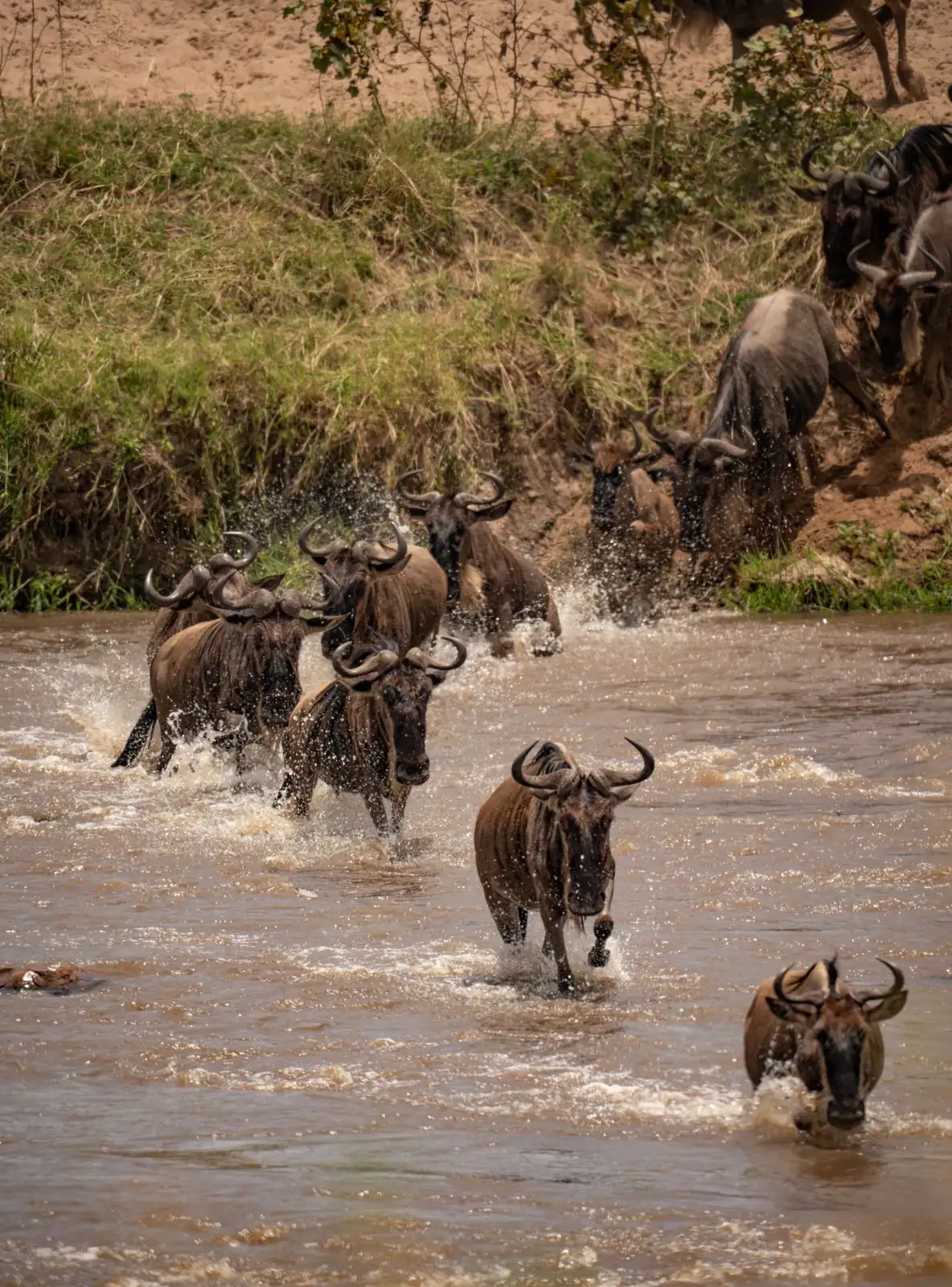
A river crossing is the most dramatic moment of the Great Migration: thousands of wildebeest and zebra hurling themselves into the Mara River while crocodiles wait below. It is also one of the hardest wildlife events to plan for, because nobody can tell you the exact day or hour. This guide explains where and when crossings happen in Tanzania, what a crossing day is really like, and how to give yourself the best chance.
What is a river crossing?
The Great Migration is the year-round movement of about 1.5 million wildebeest, along with zebra and gazelles, through the Serengeti and Masai Mara ecosystem in search of grass and water. Twice a year it meets big rivers. In June and early July the herds cross the Grumeti River in the western Serengeti. From July to October they reach the Mara River in the far north of Tanzania, and cross it many times as they move between the Serengeti and Kenya's Masai Mara. These Mara crossings are the ones you see in documentaries.
When do the crossings happen?
In most years, the first herds reach the northern Serengeti in late June or July, and crossings continue until October, sometimes into early November. August and September are usually the peak months. The herds do not cross once and leave: they move back and forth in response to rain and grazing, so the same river can see crossings for weeks.
Timing changes from year to year. A late rainy season can delay the herds by several weeks, and an early one can push them north sooner. That is why we plan crossing safaris with at least two, ideally three, nights in the north.
| Month | Where the herds usually are | Crossings |
|---|---|---|
| June | Western corridor, Grumeti River | Grumeti crossings possible |
| July | Western and northern Serengeti | First Mara crossings |
| August | Northern Serengeti and Masai Mara | Peak Mara crossings |
| September | Northern Serengeti and Masai Mara | Peak Mara crossings, fewer people |
| October | Northern Serengeti, starting to move south | Crossings continue, less predictable |
Where in Tanzania?
The Tanzanian side of the Mara River lies in the northern Serengeti, an area called Kogatende, with the Lamai triangle to the north of the river. It is wild, hilly country with far fewer vehicles than the Kenyan Mara. The crossing points have names known to every guide, and the herds choose different points on different days. Your guide talks to other guides by radio, reads the herds on the bank and decides where to wait.
Getting there takes either a long drive or a short flight. By road from the central Serengeti it is about 4 to 5 hours of game driving. By air, scheduled light aircraft fly from Arusha to the Kogatende airstrip in about two hours, with stops. Flying saves a full day and lets you arrive fresh.
What a crossing day is really like
A crossing day is about patience. You leave camp early with a picnic and find the herds massing on the bank. Then you wait, sometimes for an hour, sometimes for most of the day. The animals walk to the edge, retreat, regroup and walk back again. A zebra often leads. Then, suddenly, one animal jumps and thousands follow, a wall of noise and dust that can last from a few minutes to over an hour. Crocodiles take some animals; others are swept downstream or struggle on the steep banks.
Some days you see three crossings, other days none. Lions and leopards also hunt in the riverine bush, and the plains of the north hold big herds even when they are not crossing, so you are never short of wildlife.
How to give yourself the best chance
- Travel between mid-July and mid-October.
- Stay at least two nights in the north, ideally three, at a camp close to the river.
- Take a full-day picnic so you never have to leave a crossing point at the wrong time.
- Choose a private vehicle. A shared group tour cannot wait for hours at one spot.
- Be ready to wait with the engine off. Herds are less nervous when vehicles are quiet.
Crossing etiquette
At popular points, many vehicles can gather on the bank. Rangers enforce rules about where vehicles may park, and good guides keep well back so the herds can reach the water. If vehicles block the path, the animals choose a worse crossing point and more of them die. We ask our guides to stay back and wait, even if it means a less close photo. It makes for a better and more honest experience.
Where to stay
In the north we use camps that are as close as possible to the crossing points. Malaika Migration Camp at Kogatende is a comfortable mid-range choice. Tanzania Bush Camp's North Mara camp and Heritage Mara Camp are good-value tented camps. For luxury, Singita Mara River Tented Camp in the Lamai triangle is one of the finest camps in East Africa, with the river right in front of it. Several mobile camps move north for the season too.
River crossings in Tanzania or Kenya?
Both sides of the Mara have crossings. The Kenyan Masai Mara is smaller, easier to reach and often busier, with many vehicles at the main points. The Tanzanian side is larger, wilder and quieter, but more remote. Our comparison of the Serengeti and the Masai Mara goes into more detail.
Photographing a crossing
A crossing happens fast and you only get one chance at it, so prepare before the herds move. A zoom lens of 100–400 mm covers most situations; a second body with a wider lens is useful when the animals jump close to you. Set a fast shutter speed, at least 1/1600 of a second, to freeze the splashes, and use continuous shooting. Put your camera on a beanbag on the window frame, because you may wait an hour with it ready. Morning light is soft, but crossings often happen in the heat of the day, when the dust and the bright light are part of the story. Above all, look up from the camera from time to time. The noise, the smell and the sheer number of animals are what you will remember.
Beyond the crossings
The northern Serengeti has much more to offer than the river. The Lamai triangle and the Kogatende plains have resident lion prides, leopards in the riverine forest and some of the last black rhinos in the Serengeti. Big herds of eland, topi and elephant move through the hills. Because the area is remote, you often have sightings to yourself, which is rare in the high season. Many of our guests say the days between crossings were as good as the crossings themselves.
Booking tips
Camps close to the river are small and in high demand from July to September. We recommend booking 9 to 12 months ahead for August, and at least 6 months ahead for July, September and October. Flights to Kogatende also fill up. If you book late, consider a mobile camp or a slightly longer drive from a camp further away; a good guide can still put you in the right place.
Safaris for the river crossings
Our 8-day river crossing safari flies you to Kogatende for two nights by the river, then continues to the central Serengeti and the Ngorongoro Crater. If you prefer to travel by road at a lower price, the 8-day budget migration safari drives north to the Mara. The 10-day northern Tanzania safari adds Lake Natron and the Hadzabe. Check our migration calendar or read our month-by-month Serengeti guide, then tell us your dates.
Frequently asked questions
01When is the best time to see the Mara River crossings?
Between July and October, with August and September usually the peak. Exact timing changes every year with the rains.
02Can you see river crossings in Tanzania?
Yes. The Mara River runs through the northern Serengeti in Tanzania, around Kogatende and the Lamai triangle, and crossings happen there from July to October.
03Are river crossings guaranteed?
No. Crossings are a natural event and can happen at any time. Staying two or three nights near the river gives you a very good chance.
Ready to plan?
Tell us your dates and travel style and we will shape a route around them.